
Indian River Ten-Day Arrest Window
IRCSO's Public Records page serves as the county's official multi-day source. It posts weekly arrest affidavits and case files as downloads. One catch stands out. Only the last ten days of public records stay available. Files roll off quickly. Each entry is a separate PDF rather than one chronological arrest roster. The set is not a promise that every booking from the span appears. Some dates have arrest-report and case-report links. Others do not. A document can post after the arrest, then vanish once it passes the ten-day window. For current custody, the live inmate roster remains the better tool.
Read Indian River Arrest Affidavits
Dates and document type come first in any blotter search. Arrest affidavits carry narrative and probable-cause context, while case-report files belong to a different record category entirely.
- Open the official public-records page and locate the recent affidavits or case-file list.
- Compare the document date with any arrest date and booking date shown inside.
- Identify the arresting agency, person, charge, and incident or booking number.
- Check the live IRCSO roster if current custody matters.
- Use the Clerk's case view for the later filing, hearings, and disposition.
The Daily Arrest Report is the separate route for current-date and prior-date booking cards.
Indian River Log Entry Fields
The exact fields vary from PDF to PDF, and protected material may be redacted. These categories follow Florida's standard booking-record description.
| Field | Use |
|---|---|
| Person and identifiers | Match the record without assuming identity from a name alone. |
| Document and event dates | Separate posting, arrest, and booking timing. |
| Arresting agency | Identifies the office that created the enforcement record. |
| Charge description | Records the booked charge, not guilt. |
| Incident or booking number | Supports a precise follow-up request. |
| Affidavit context | Provides the reported basis, subject to redaction and later court change. |
Charges can change as a case moves through court. Treat affidavit language as the arresting agency's account, not a final determination.
Official Indian River PDF Window
The captured IRCSO public-records screen shows the county's multi-day download format.
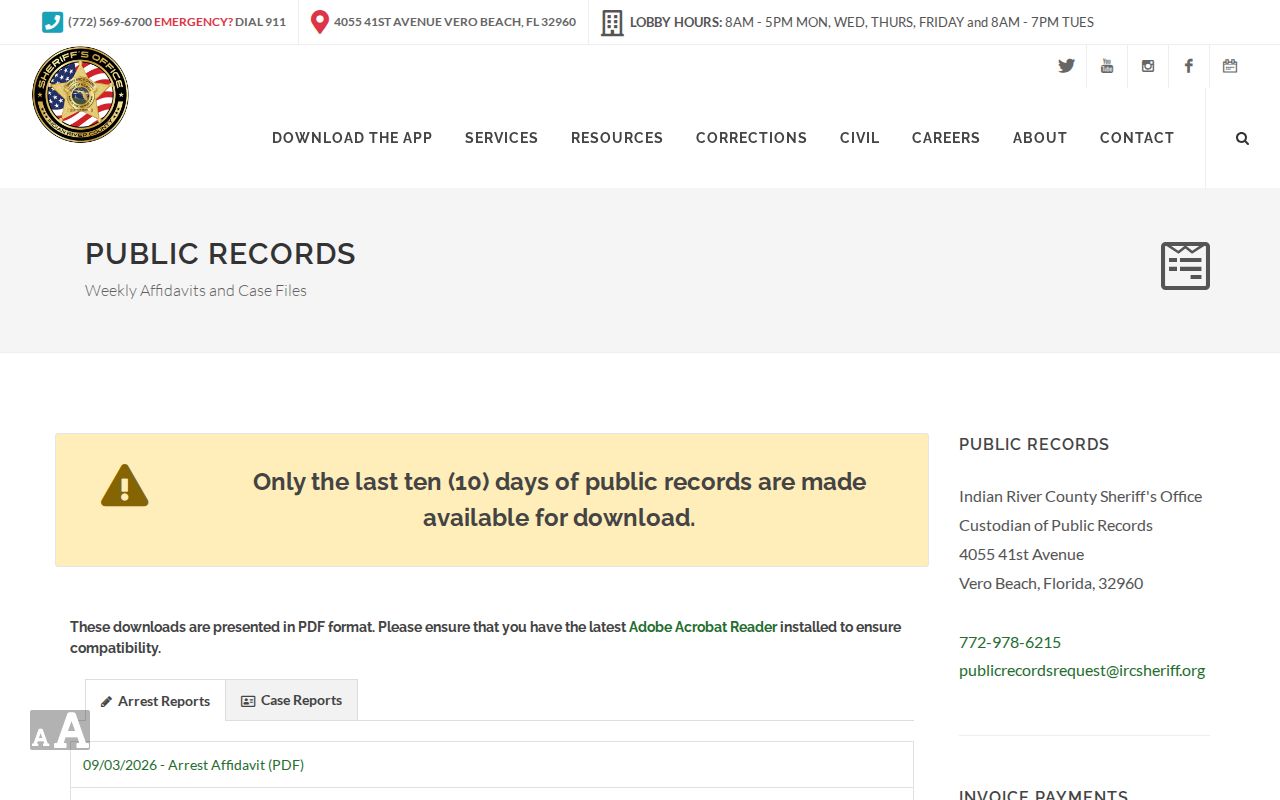
The live list may contain different dates because the published window rolls forward.
Indian River Posting Gaps
The county publishes no fixed posting schedule. It has no weekend cadence and no permanent document archive. A missing date may reflect posting practice rather than a lack of arrests. A city police blotter also runs on its own schedule. It cannot substitute for the jail roster. IRCSO's current-inmate count shifts constantly. That alone shows the gap between live custody and a batch of posted arrest reports. When a question spans both, check the roster and the affidavit separately. Note: The ten-day label describes online availability of posted files, not a guarantee of every arrest across ten consecutive days.
Indian River News Blotter Context
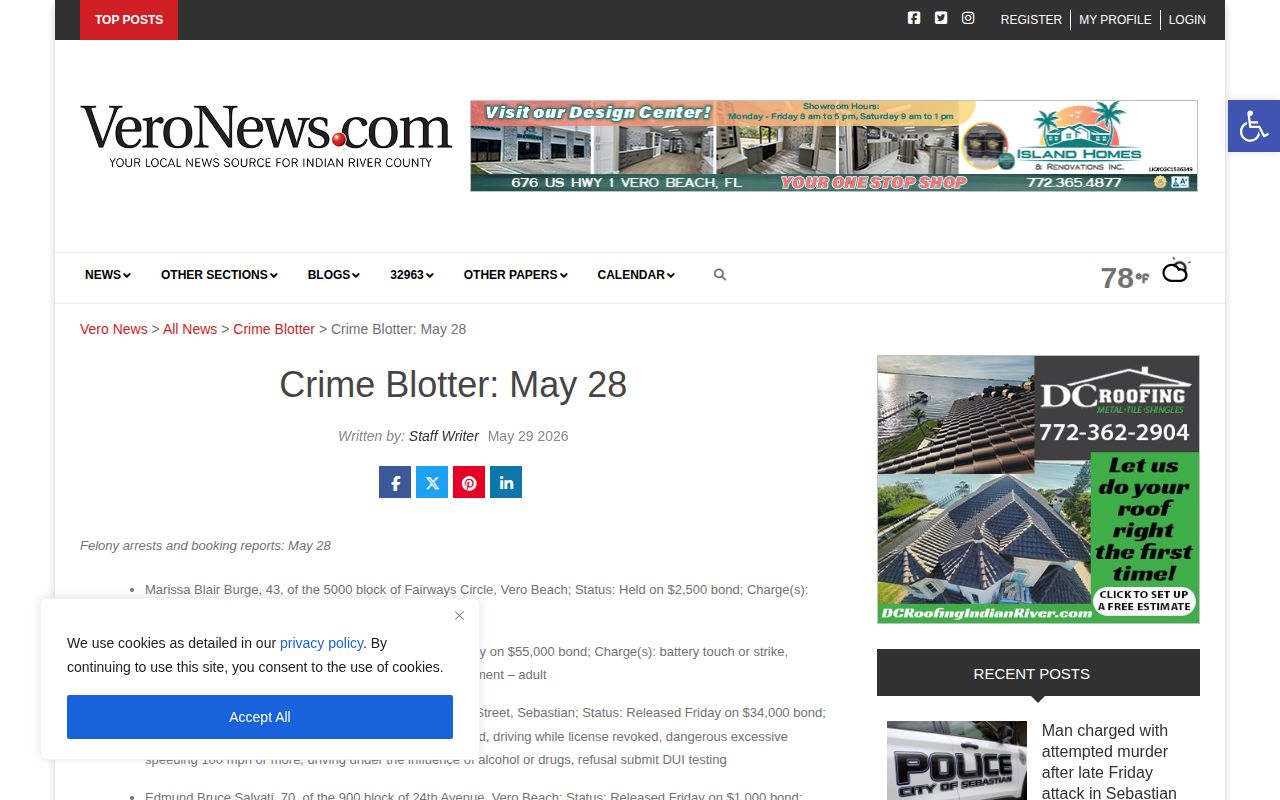
Vero News publishes recurring crime blotters built from IRCSO information. Its own caveat is worth noting. A person may have been arrested earlier and booked on the listed date. Blotter dates are not always arrest dates. The outlet is secondary, so weigh it against IRCSO and the court record.
News coverage rounds out the record. It is not, however, a custody database or a booking-photo source. The archived Hometown News Indian River Arrest Report sorts older weekly entries by agency. It groups Sebastian Police, Vero Beach Police, and IRCSO. Vero Beach 32963 takes a different approach. It runs selected crime and court stories rather than a complete arrest feed.
Indian River Case-Story Coverage
The Vero Beach 32963 source offers story-based local coverage that follows selected cases.

Stories like these are selective by nature. They may use different dates, and they never replace the official arrest log or the later court docket.
Archive Indian River Arrest Records
Once a PDF rolls off the site, request the record directly from IRCSO Records. Reach the office by email at publicrecordsrequest@ircsheriff.org. Call (772) 978-6215. Write to 4055 41st Avenue, Vero Beach, FL 32960. Give the person's full name. Say what you want. Ask for the affidavit, booking card, photo, commitment or release list, or jail docket entry. Add the approximate booking date, the arresting agency, and any incident or booking number. Florida's GS2 law-enforcement schedule sets minimum retention rules for agencies, not website display promises. Booking record copies and commitment or release lists carry a one-anniversary-year-after-release minimum. Jail docket copies are permanent under that schedule. Ask IRCSO which category fits. For court records, the Indian River County Clerk's case search is the next path. Its images generally reach back to late 2008. Earlier access is handled case by case.
Request Indian River Log Files
A focused request beats a broad one. Name the record series, the date range, the arresting agency, and any incident or booking number. Say what you want. Options include an affidavit, booking card, booking photograph, commitment and release list, or jail docket entry. The official policy is blunt on limits. The agency need not create a new record. It also need not answer questions, perform free research, or convert material into a different format on request. If something is withheld, ask for the exemption or redaction basis. Request any nonexempt portion that can be released. A blank online list is not a formal response from the custodian. The ten-day display is just a convenience window. The underlying record can still fall under a longer retention rule and the normal public-records process.
Florida Arrest Archive Categories
Florida's GS2 schedule sorts arrest paperwork into distinct series. Daily bulletins cover one twenty-four-hour span. They stay on file only until obsolete. Offender arrest information follows the same rule and can also be superseded. It can lose administrative value too. Booking records, commitment and release lists, and jail docket books are separate series. Each carries its own minimum retention period. The jail docket record copy is permanent. That is why a single web expiration date can never speak for every underlying file.
A booking photograph may sit inside a booking record or an investigative one. The schedule offers no universal mugshot retention period. Ask IRCSO which series holds the image and which rule governs it. A photo can drop off the public page. That does not mean it was destroyed. The reverse holds too. Agency retention never requires an image to stay on display online.
For how a case ended, read the affidavit beside the Indian River County Clerk docket. Match county, division, dates, parties, and charges, since one name can pull up several cases. Prosecutors and courts can change the charge after the blotter appeared. A news article or an old PDF rarely tells the whole story.
Public Record Search
Sponsored Results